
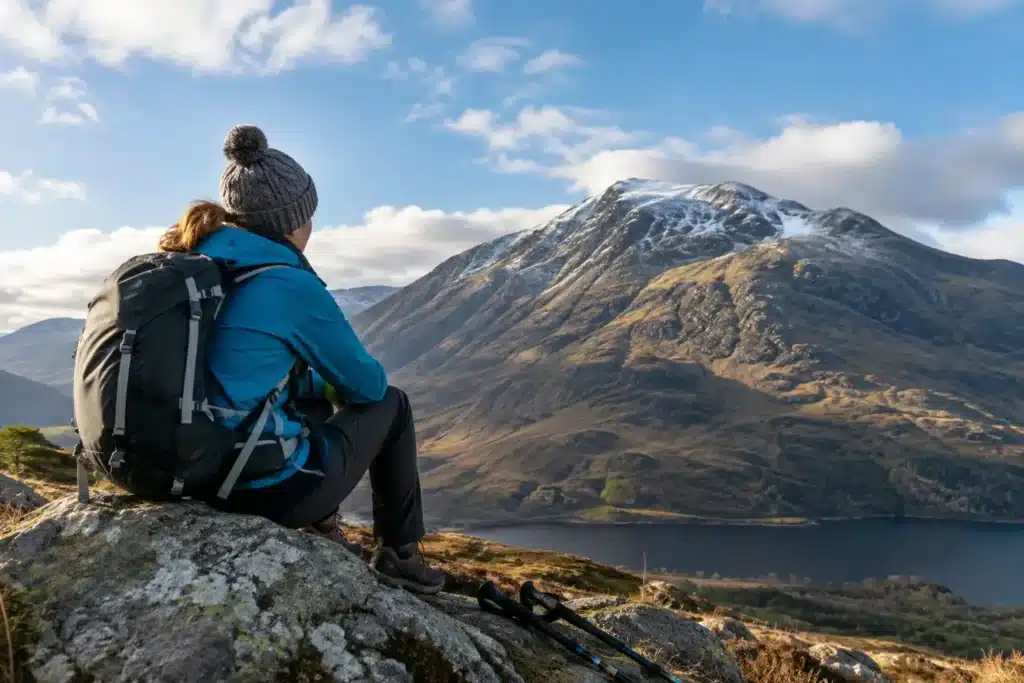
Ben Nevis is often described simply as Britain’s highest mountain. At 1,345 metres, it is certainly that – but height alone does not explain the experience. A clear morning can begin with a straightforward walk through Glen Nevis and end in cold cloud, strong wind and loose, rocky ground near the summit. Good preparation makes the day more enjoyable, and gives you the best chance of returning with tired legs, dry kit and a story worth sharing.
For many visitors, the mountain is the centrepiece of a Highland holiday. For others, it is one stage of a longer walking or climbing trip. Whichever applies, treat it as a proper mountain day rather than a quick local outing.
Choosing the Right Ben Nevis Route
The route most walkers use is the Mountain Track, formerly known as the Tourist Track. It starts from Glen Nevis and climbs steadily on a well-established path, following a series of long zig-zags before reaching the stony summit plateau. It is the best option for fit walkers with suitable clothing, footwear and enough time, but its name should not be mistaken for a guarantee of easy conditions.
Allow a full day. Many parties take seven to nine hours, depending on fitness, weather, breaks and how busy the path is. The distance is roughly 17 kilometres there and back, with sustained ascent and descent. The walk is demanding on knees and ankles, particularly on the way down, when tiredness can affect concentration.
The Carn Mor Dearg Arete is a much more serious alternative. This is a magnificent high-level mountain route for experienced, confident hillwalkers in settled conditions. It involves a long day, exposed ground and careful navigation. It is not a sensible substitute for the Mountain Track if you are new to Scottish hills or if the forecast is uncertain.
In winter, Ben Nevis becomes an entirely different undertaking. Snow, ice, avalanche risk, very short daylight hours and difficult navigation can all be factors. Winter climbing or walking requires the right equipment, knowledge and judgement. If you do not have that experience, go with a qualified guide or choose a lower-level day out instead.
Read the Forecast for the Mountain, Not the Town
Fort William can be calm and bright while the summit is in cloud, below freezing and exposed to severe wind. Check a mountain-specific forecast before setting off, including wind speed, cloud base, rainfall, temperature and the likelihood of snow or ice. Conditions can change during the day, so review the forecast again on the morning of your walk.
Low cloud is one of the main reasons people lose their way on Ben Nevis. The summit plateau is broad, rocky and featureless in mist, and the descent line requires care. Do not rely on seeing other walkers, following footprints or using a phone signal. Take a paper map, compass and know how to use them. A charged phone and a mapping app are useful additions, not replacements.
Be willing to turn round. This is not a failure, and the mountain will still be there on another day. If the wind is stronger than expected, cloud has reduced visibility, a member of your group is struggling or the ground becomes icy beyond your ability, a lower walk can be the better call.
What to Carry for a Comfortable Climb
A small day sack needs to hold more than a water bottle and a snack. Weatherproof jacket and trousers, insulating layers, hat and gloves are sensible in every season. The summit can be markedly colder than the glen, even in summer, and rain can arrive quickly.
Sturdy walking boots with reliable grip are strongly recommended. Trainers may feel comfortable at the start but offer limited support and traction on wet, uneven stone. Bring enough food for a long day, water or a way to refill it safely, and a few high-energy items that are easy to eat when you are tired.
A headtorch is worth carrying even if you expect to finish in daylight. Delays happen: a slower group member, a wrong turn, a longer rest or a change in weather can all extend the day. A basic first-aid kit, whistle, emergency shelter and fully charged phone are also sensible for a mountain of this scale.
In the colder months, footwear and clothing alone are not enough. If snow or ice is present, you may need winter boots, crampons, an ice axe and the skills to use them correctly. Carrying technical kit without knowing how to use it can create false confidence.
Timing Your Ben Nevis Day
An early start gives you more daylight, more flexibility and a better chance of avoiding the busiest period on the path. It also leaves time for an unhurried breakfast before setting out. Starting late can turn a manageable summer walk into a race against fading light, especially if the weather slows progress.
Build in time at the summit, but keep it realistic. On a clear day, the views across the Highlands can be extraordinary. In cloud, the sensible priority is navigation and a safe descent rather than waiting for a break in the weather. The summit ruins are a reminder that this is an exposed place, not somewhere to linger when conditions are poor.
Your group should travel at the pace of its slowest member. Agree this before you leave. Splitting up can make a difficult situation harder, especially in mist or on the descent. If someone needs to stop, gets cold or develops pain, deal with it early rather than hoping it will improve higher up.
Planning Your Stay Around the Mountain
A good night before the climb matters more than many people expect. Mountain days begin better after proper rest, a filling breakfast and a chance to organise equipment without rushing. Staying locally also allows room for flexibility: if the forecast shifts, you can move Ben Nevis to a better day and enjoy another Highland walk, a scenic drive or a visit to nearby attractions instead.
After the descent, practical comforts make a real difference. Wet jackets, muddy boots and tired legs are part of the experience, but they need not take over your room or car. Walkers and climbers often value somewhere to dry gear, store boots and settle in with a hot shower before heading out for supper or enjoying a quiet drink.
At Guisachan Guesthouse, guests can make use of a drying room, secure bicycle storage, free parking and EV charging alongside comfortable en-suite rooms and a hearty Scottish breakfast. It is the kind of straightforward support that helps when your plans revolve around the weather, early starts and well-used outdoor kit.
Respecting the Mountain and Other Walkers
Ben Nevis is popular for good reason, and a little consideration protects the experience for everyone. Keep to the established route where possible, take all litter home and avoid leaving food scraps behind. The path may be busy in summer, so allow faster walkers to pass when it is safe and do not block narrow sections during breaks.
Toilets and bins are not available on the mountain itself. Plan ahead and follow responsible outdoor practice. If you bring a dog, consider whether it is suited to a long, rocky ascent, changing weather and a potentially crowded path. Livestock and wildlife also deserve space and calm handling.
Most importantly, let someone know your intended route and expected return time. If you change plans, update them. This small habit is useful whether you are walking alone, as a couple or with a larger group.
Ben Nevis rewards preparation rather than bravado. Choose a day that suits your ability, pack for the summit rather than the car park, and leave enough time to enjoy the walk at your own pace. The best mountain day is not necessarily the one that reaches the top at all costs – it is the one that brings you safely back, ready to appreciate the Highlands again tomorrow.