
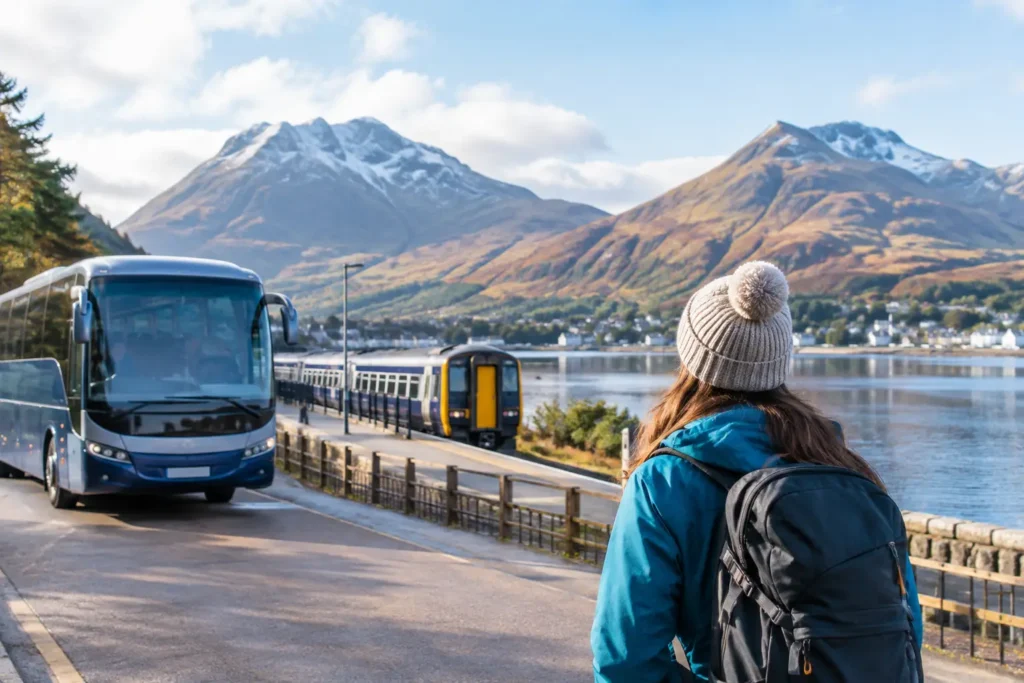
Fort William is compact enough to explore on foot, yet it sits at the meeting point of some of the Highlands’ biggest journeys. This Fort William transport guide is designed for visitors arriving with walking boots, bicycles, family luggage or a car full of outdoor kit – and for anyone who wants to spend less time working out connections and more time enjoying the landscape.
The best way to travel depends on your plans. Rail and coach work well for town-based sightseeing and linear walks, while a car gives greater freedom for remote glens, early starts and changeable weather. There is no single right answer, but a little planning makes a significant difference here.
Arriving in Fort William
Fort William is well connected by Highland standards, although distances are greater and services less frequent than visitors may be used to in cities. Build some flexibility into your arrival day, particularly in winter or when you are relying on a last connection.
By train
Fort William railway station is in the town centre, within easy walking distance of shops, places to eat and many accommodation options. It is a useful arrival point for guests travelling from Glasgow, as well as for those using the overnight Caledonian Sleeper service from London.
The railway is also part of the experience. The West Highland Line between Glasgow and Fort William is widely regarded as one of Britain’s great scenic rail journeys, passing lochs, moorland and mountain country. From Fort William, trains continue west towards Mallaig, calling at Glenfinnan and other small stations along the way.
Rail is particularly practical if you are finishing the West Highland Way in Fort William, travelling light for a short break, or planning a day at Glenfinnan without driving. Do book ahead for busy periods where possible, especially in summer, around school holidays and on weekends. If you are bringing a bicycle, check cycle space requirements before setting off, as capacity can be limited.
By coach and local bus
Long-distance coaches connect Fort William with Glasgow, Inverness and other Highland destinations. They can be a good-value choice for solo travellers and walkers, and they remove the need to collect a hire car after a long journey. The coach stops are centrally placed, making onward travel straightforward if your accommodation is nearby.
Local buses serve nearby communities and some visitor destinations, but routes may not run frequently, particularly on Sundays, in the evening or out of season. A bus can be ideal for a planned day out, but it is less suitable for a tightly timed itinerary with several stops. Always check the current timetable close to travel, rather than relying on an old printed schedule or a search result from a previous season.
By car
Driving is the most flexible option for visitors hoping to combine Fort William with Glencoe, Lochaber villages, Ardnamurchan, Skye or quieter walking routes. The A82 provides the main approach from Glasgow and Inverness, while the road west to Mallaig opens up the Road to the Isles.
That flexibility comes with a few realities. Highland roads can be narrow, winding and slow-moving, and journey times are often longer than the mileage suggests. In summer, popular car parks fill early; in winter, snow, ice and high winds can affect mountain roads. Leave time for photo stops, passing places and the occasional herd of deer or sheep near the road.
If you are hiring a car, choose a size that suits your confidence as well as your luggage. A large vehicle may be comfortable on the motorway but less relaxing on single-track roads. Drivers should never park in passing places, as these are essential for traffic to move safely in both directions.
Getting around Fort William without a car
The town centre, railway station, High Street, Loch Linnhe waterfront and several local services are walkable. For a relaxed short stay, it is entirely possible to arrive by train or coach and use a mixture of walking, buses and taxis.
A sensible pair of shoes is still useful. Pavements can be wet, and a route that looks short on a map may include a slope or a stretch beside a busy road. If you are carrying camping equipment, climbing gear or several bags, arranging a taxi for the final part of the journey can be worth it.
Taxis for early starts and tired legs
Taxis are valuable in Fort William, especially for an early Ben Nevis start, a late train arrival or transport to a trailhead not served by a convenient bus. Demand can be high during the main visitor season, so pre-booking is wise when timing matters. This is particularly true for groups, cyclists with luggage and walkers needing a lift after a long day.
Do not assume a taxi will be waiting at every rural station or attraction. If you are using one-way transport for a walk, confirm both your pickup point and your mobile signal arrangements in advance.
Cycling around Lochaber
Fort William is a strong base for cyclists, with mountain biking at Nevis Range and road or gravel rides across the surrounding area. Cycling around town can be convenient, though traffic, weather and hills mean it will not suit every visitor. E-bikes make local distances more manageable, but battery range can drop quickly in cold conditions or on sustained climbs.
For touring cyclists, secure overnight storage and somewhere to dry wet clothing can matter as much as the route itself. Guisachan Guesthouse offers secure bicycle storage and a drying room, helping riders start the following day with kit that is organised and ready to use.
Transport for popular Fort William days out
Ben Nevis and Glen Nevis
The Mountain Track for Ben Nevis begins in Glen Nevis, a short distance from the town centre but not always a straightforward walk with a full mountain pack. Driving gives the most control over your start and finish time, although parking can be busy on clear summer mornings. Taxis can be a sensible alternative if you do not have a car.
For any Ben Nevis day, transport needs to support the mountain rather than dictate your decisions. Weather may require a later start, an earlier return or a complete change of plan. Do not commit to an inflexible connection that encourages you to rush on the hill.
Nevis Range
Nevis Range is outside central Fort William, near Torlundy. It is easily reached by car and may be served by local transport at certain times, but service patterns can vary. Visitors using the gondola, bike trails or ski facilities should check both transport and attraction operating information before leaving town, as Highland weather can affect both.
A car is convenient when carrying mountain bikes, ski equipment or family day bags. Without one, a pre-arranged taxi is often the least stressful option, particularly if you are travelling outside the busiest part of the day.
Glenfinnan and the Road to the Isles
Glenfinnan is one of the easiest major excursions from Fort William by train. The rail journey is scenic in its own right, and arriving by train avoids pressure on the village car park during the busiest months. Allow time to walk between the station, monument and viaduct viewpoints, and remember that the route can be muddy after rain.
The Jacobite Steam Train is a memorable visitor experience, but it should be treated as an attraction rather than the backbone of a time-critical travel plan. It is popular, seasonal and subject to operational changes. If seeing the viaduct is your priority, regular rail services or a car journey can offer more flexibility.
The West Highland Way
For walkers completing the West Highland Way, Fort William is a natural finishing point and a place to pause before travelling on. The railway and coach station make onward journeys possible without returning to the start of the route, while baggage storage can make a final afternoon in town more comfortable.
If you are beginning a different walk from Fort William, check whether your route is truly accessible by public transport. Some trailheads have limited services, and a taxi transfer may be the practical choice. It can cost more than a bus, but it may save hours and preserve energy for the walk itself.
Plan for weather, luggage and timing
Highland transport planning is rarely just about the timetable. Rain can turn a short walk into an uncomfortable one, strong winds can affect outdoor activities, and a delayed mountain day can alter your evening plans. Keep waterproofs, a warm layer, snacks and a charged phone accessible rather than buried at the bottom of your case.
If you are arriving by car, choose accommodation with parking before you set off, rather than assuming town-centre spaces will be available. If you drive an electric vehicle, plan charging around your wider route rather than waiting until the battery is low. For rail and coach travellers, pack so that you can manage your own bags between stops, or consider leaving non-essential luggage securely at your accommodation.
The most comfortable Fort William trips usually have one fixed element each day and room around it: a train to Glenfinnan, a booked taxi to a trailhead, or a car parked for a mountain walk. Leave the rest open enough to follow the weather, take the longer viewpoint path, or enjoy a warm drink after a wet afternoon. That small margin is often what makes Highland travel feel like a holiday rather than a timetable to chase.